4° at the start, rising to about 10° · Clear sky all morning, clouding over past Stow · Light headwind out, tailwind home
I. The First of Nineteen
Saturday, the 18th of April. 8:45. Voice and time check. The Witney parkrunners are assembling on the sports ground at West Witney, pulling on their jackets and laughing into the cold, and I am turning the other way out of town on a bicycle, holding a little recorder in my jersey pocket and setting off on a big ride.
It is only my second outing with the new pedals — the clipless kind, the sort that hold your feet to the bike whether you want them to or not. The aim for today, above all else, is not to fall over at a junction. There will be other ambitions, some of them more serious, but that one is the baseline.
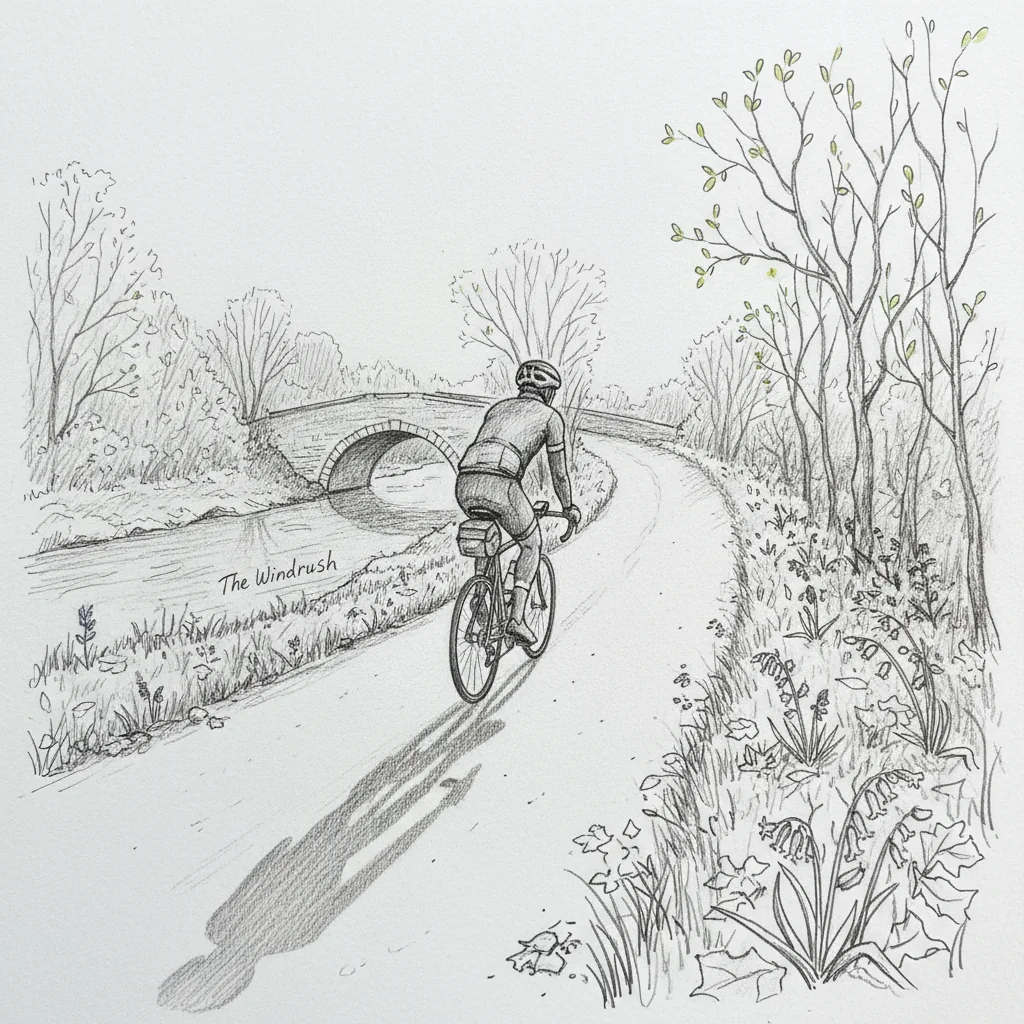
The sun is out but hasn’t yet warmed the air, and my fingers and knees are complaining. Still, it is pulling the bluebells into flower in a way they weren’t doing just a fortnight ago. Everything is about to happen at once, the way it does in April. I cross the Windrush on the way out of town, and for the first time in weeks the river is properly back within its banks instead of spread across the road like a shallow ornamental lake.
My cycling computer chooses this moment to tell me that I am now on hill one of nineteen.
Nineteen. I think that might be a personal record for a single ride. And the biggest of them — the one that I have been aiming at for weeks and that has pulled me out of bed this morning — is the long climb up the escarpment from Broadway to the Cotswold ridge. Big for me, anyway. If I don’t abort before then.
Hill one is gentle enough. It is up on the crest of it that I meet my first pheasant of the day: coppery-chested, almost exactly the colour of the ploughed soil, standing still in a way that only makes sense when you realise it is pretending it cannot be seen.
◊
II. Field Assarts
I am climbing up onto what I immediately think of as the field assarts. This is a real name, as it happens — there is a hamlet called Field Assarts just north-east of here, and an assart is a piece of forest grubbed out to make fields, from Old French essarter. This is the edge of what was once the great royal hunting forest of Wychwood, recorded in the Domesday Book and covering, at its medieval peak, around two hundred square kilometres. Assart rents were paid to the Crown for every piece of wood turned into farm. The fields I am riding between are, quite literally, clearings; and the -leigh on so many place names around here — Leafield, Asthall Leigh — is the Old English lēah, a clearing in a wood. Asthall sits down in the valley by the Windrush, where the original settlement grew up along the river; Asthall Leigh is the same parish’s ridgetop clearing, and Fordwells, the hamlet just beyond, only appeared as a settlement in the eighteen-sixties after enclosure. It is a young village by any Cotswold standard. I roll through all three of them, on a lane so quiet that for a good half an hour I have not seen a car move.
Pheasants everywhere. Two squirrels hold a short conference over which side of the road to dash to; both choose the same side; neither is flattened. I file that under small mercies.
A footpath sign points off to Leafield and I press on up through pine plantation and grassy track. Hill three — sixty-eight metres of ascent over two miles — is exactly the kind of plodding climb I need the legs to get used to. I’m cycling between farmland but there is no farm activity this morning. The only thing to hear is the birds. The Beeline, as always, is finding me lovely quiet road.
You wonder, on a road like this, how different the land would have looked two hundred years ago. Some of the stone buildings look as if they could just about be that old — renovated, but with the same shape and weight. The power lines are obviously new. I don’t know when pylons were really rolled out across the UK — the late forties or fifties, presumably, and later this far out. The tell-tale three-pronged phone masts would be late nineties, early noughties, probably replaced several times already as we have jumped through second, third, fourth and now fifth generation.
The lambs that were teeny weeny a few weeks ago are now a little more solid. Hopefully big enough to be off the menu for a red kite. As much as I love my red kites, it does seem mean to be picking off the lambs.
I pass Langley Farm, and an old house set into the side of the hill — more than two hundred years old, more probably much older; this may be the ridgetop farmhouse known as King John’s Palace, a mediaeval hunting lodge visited by a string of monarchs between 1204 and 1614, though it sits unsignposted from this side and I can’t be sure. Either way, it is the kind of house that looks as though it has grown out of the hill rather than been put on top of it.
The road levels. I am getting a bit of headwind on the crest. I know this hill well — it’s part of one of my favourite Swinbrook loops — but I have only ever ridden it the other way, and doing it in reverse is like reading a familiar poem backwards. Everything is in the wrong place.
I watch the lambs do their two-legged jump. That strange little hopping bounce they do — spring-loaded, delighted, pointless. Nothing else I can think of quite speaks of youth and joy and freedom in the way a lamb does, jumping like that.
I am enjoying the lamb so much that I am almost taken out by a pothole.
Which reminds me. We are about to cross the B4437 — the road on which the Transport Secretary, Heidi Alexander, recently hit a pothole so deep that her Mini had to be towed away. Her green Mini Cooper — green in both senses — struck what she described to the press as “a crater worthy of the moon” on the way back to her Swindon South constituency. The timing was exquisite: the story broke just before the government announced new penalties for councils that failed to fix their roads. There is something deeply British about a cabinet minister being towed off the tarmac by the AA, and I love the fact that a member of the government is driving herself around in a Mini like anyone else. No aristocratic motorcade. No protective bubble. Even ministers are subject to potholes.
A great leveller.
Leafield recedes on my right, Swinbrook falls away behind me, and ahead lie the Wychwoods: Shipton-under-Wychwood, Milton-under-Wychwood, Ascott-under-Wychwood. Three villages still carrying the suffix of the old royal forest — settlements under the boughs of a wood that is mostly no longer there.
All that energy we have built up going up the hill, we are about to burn in a big downhill.
◊
III. Into the New
Somewhere near Shipton I pick up Cycleway 442 — National Cycle Route 442, it turns out, the Cotswold Line cycle route, fifty-three miles connecting Worcester to Long Hanborough along the line of the railway. I had no idea. I had seen the sign a dozen times and never looked it up. A GWR train passes underneath me as I cross the bridge at Shipton station, heading back to Paddington, and I think for a moment about investment from several generations ago. Whether the current splurge of spending on AI will leave us anything remotely like a Victorian railway. Probably not. It will leave us a lot of data centres, and data centres do not have the same silhouette at dusk.
Diesel at £1.93 a litre at the forecourt as I cycle past. I have been driving electric for five years and I’m out of touch. It is a reminder that the wider world is still out there beyond sleepy Oxfordshire, with all its prices and its shortages. A thirty-mile-an-hour sign with a digital “your speed” display flashes me at twelve. Very encouraging. I wave at it anyway.
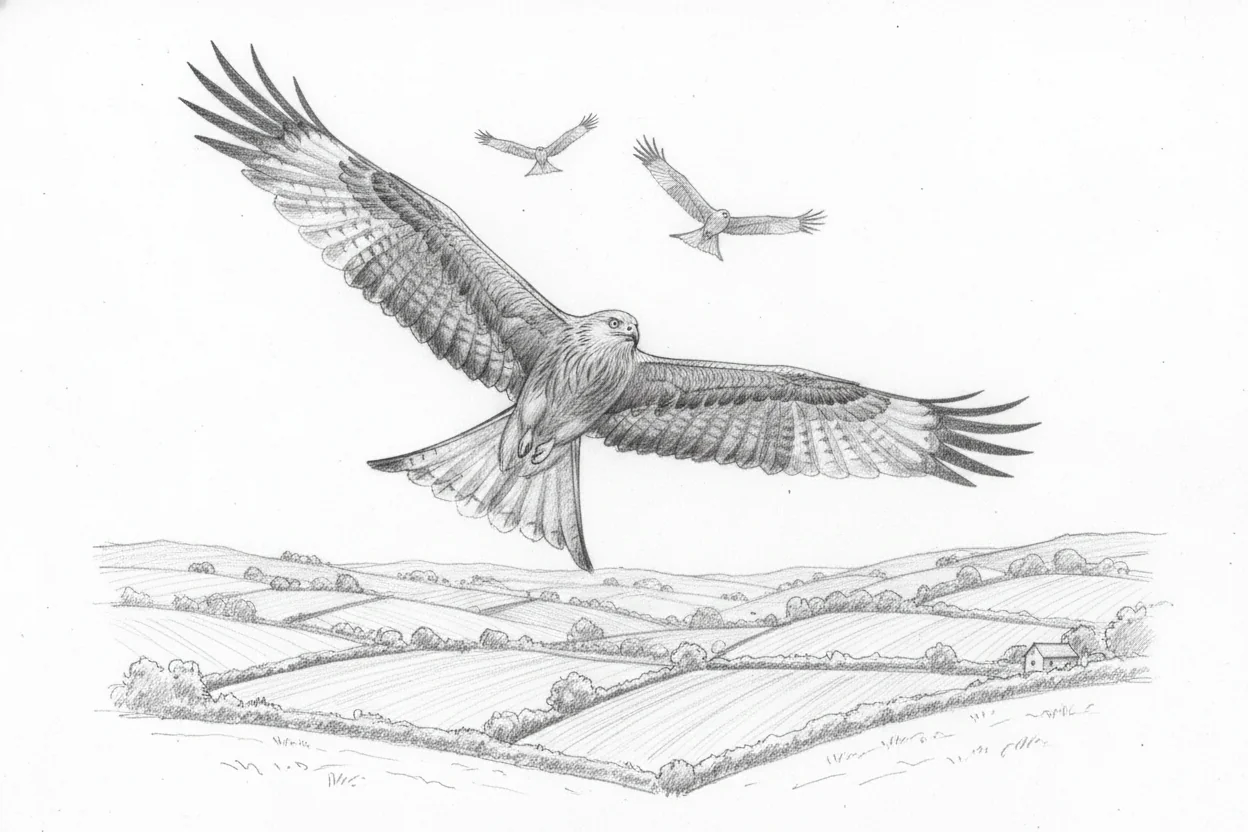
Three red kites in a holding pattern
Three red kites in a holding pattern over a field. The forked tails, the russet underwings, the slow patient circles. I have written before about the miracle that brought them back to this landscape; I will not rehearse it here. What I will say is that three kites together, hanging in the same thermal, is a thing you would not have seen in this county in my lifetime until recently, and that the sight still stops me on a cold morning. They drift off behind me. I push on.
I drop into Lyneham — a parish that was a chapelry of Shipton-under-Wychwood until eighteen ninety-five. Couple of horses out walking side by side on a pretty main road. Very patient animals.
The satnav now predicts I will get home at one thirty-six. Four hours and two minutes from now. I am still holding on Cycleway 442, and it carries me towards the Wild Rabbit — a pub near Kingham that I would love to go to one day, and which reportedly has a cookery school and rooms to match — and then, with a small pang of regret, peels off in a different direction. The satnav has other ideas today.
I crisscross the railway again at Kingham station, the car park already quite full for a Saturday morning. A little further and I am into Gloucestershire. Last time I came this way I turned left towards Foscot and Idbury. This time the road sends me right, towards Bledington and Stow. Haven’t come out this far in this direction before.
A little group of teenagers trudges past, hi-vis tied to their rucksacks as though to muffle it, trying to look cool in the morning light. Scouts, probably, or Duke of Edinburgh — out on a bronze expedition by the look of them. Same sort of morning for it as mine.
Bledington is lovely. There is a fragrance of wood smoke from someone warming up their house on a cold morning, and somewhere close to it the unmistakable smell of bacon cooking. I cross the tiny brook on the village green, and there, sixteenth-century, all Cotswold stone and inglenook fireplace, is the King’s Head Inn, built originally as a cider house and now one of the most decorated pubs in the Cotswolds. Inviting, obviously inviting. But I’m not stopping. I have a lot of hill to climb before I earn a stop.
The downside of the new pedals is becoming clear. An hour in, my feet are freezing. There is no real room to wiggle them around, and the blood is just not moving. I grit my teeth, or my feet, and press on.
I enter Ganborough — a hamlet on the edge of Longborough, about two miles north of Stow. The Heart of England Way strikes off to my right. I feel I ought to be at the top of a hill, but the Beeline insists there are another sixty-six metres of ascent ahead of me somewhere.
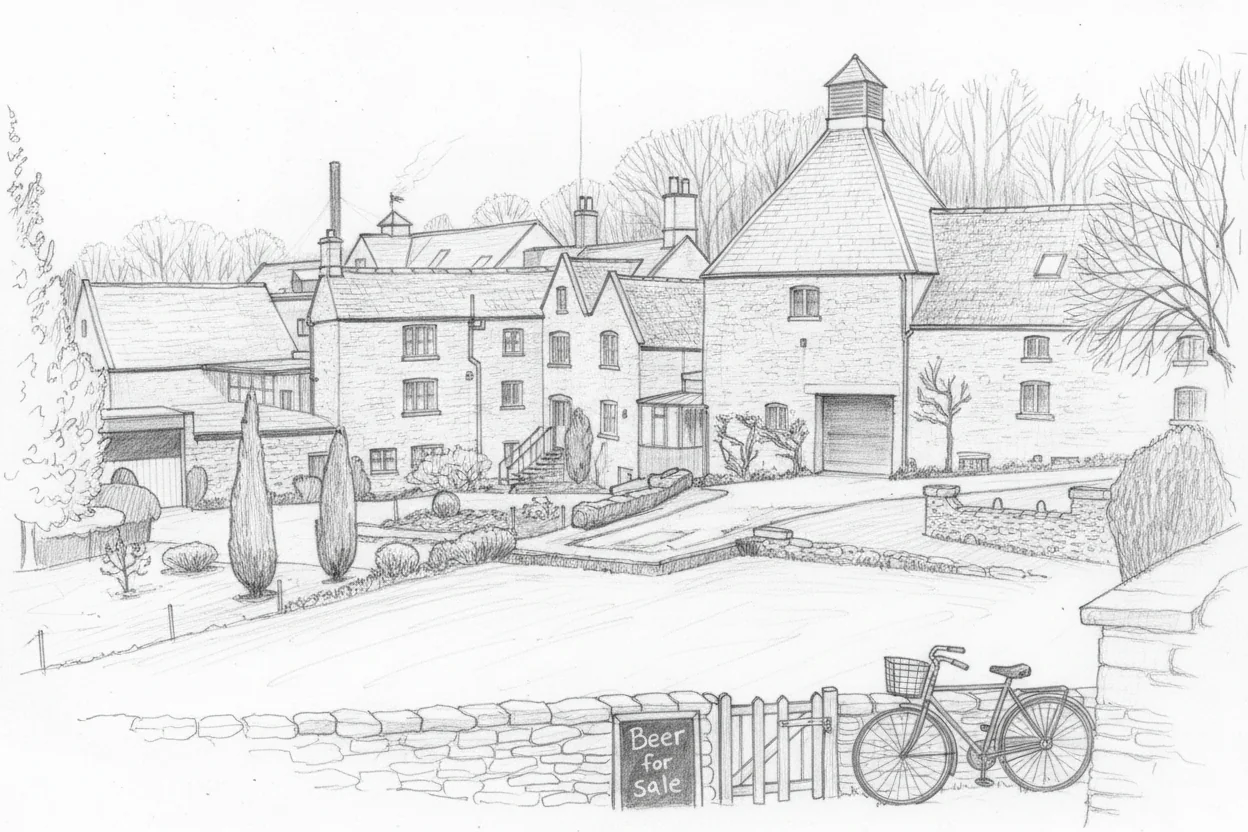
Donnington Brewery on the Dikler
And then, unmissable even at twelve miles an hour, Donnington Brewery — a mill on the River Dikler that has been grinding something since twelve-ninety-one, and brewing beer since the Arkell family bought it in eighteen-twenty-seven. Still brewing now, still family-run, still supplying twenty or so tied Cotswold pubs. A working overshot waterwheel, all the original grinding mechanics still inside. Cotswold stone, very handsome. Beer for sale on a board at the gate.
Bit early.
◊
IV. The Monster
A sign to Broadway. The first one I’ve seen.
I had half-expected the run-in to the big climb to feel momentous, but in fact it is the opposite. I pass a very welcoming café just outside Ganborough — the Cotswold Barn, as I will later discover, family-run by Joanne and Bernard Williams and their daughter Lucy — and I don’t stop. There is some ridiculous rule in my head that says I cannot allow myself a break before the halfway mark. It is not a good rule. But it is the rule for today.
Snowshill Hill is where I’m going. I do not like the name. To a cyclist, Hill is always bad news; Snowshill Hill is the same bad news twice in quick succession; and Snowshill Hill Road pushes it to three. It is the kind of name that sounds funny until you have to ride up it.
I am about a mile out from Snowshill Manor — the sixteenth-century house where, from nineteen-nineteen until his death, Charles Paget Wade amassed a collection of more than twenty-two thousand objects embodying the essentials of design, colour and craftsmanship: twenty-six suits of samurai armour, bicycles, toys, musical instruments, clocks, costumes, the entire Arts-and-Crafts world in one house. Wade himself lived in the Priest’s House next door. He gave the manor and everything in it to the National Trust in nineteen-fifty-one.
I don’t see the manor from the road. What I do see is a deliberate cut in the trees, off to my right, and through it an enormous stately home — which, later, with maps spread across the kitchen table, I will identify as Springhill House, about three kilometres east of Snowshill, set in its own fifty-hectare park sloping away from the ridge. Built around seventeen-sixty-three by Lancelot “Capability” Brown for John Bulkeley Coventry, the youngest son of the fifth Earl of Coventry, as a quiet retreat from the family seat at Croome Court. Hold onto that name. It will come back.
A skylark launches itself vertically from the field beside me, pouring song into the sky.
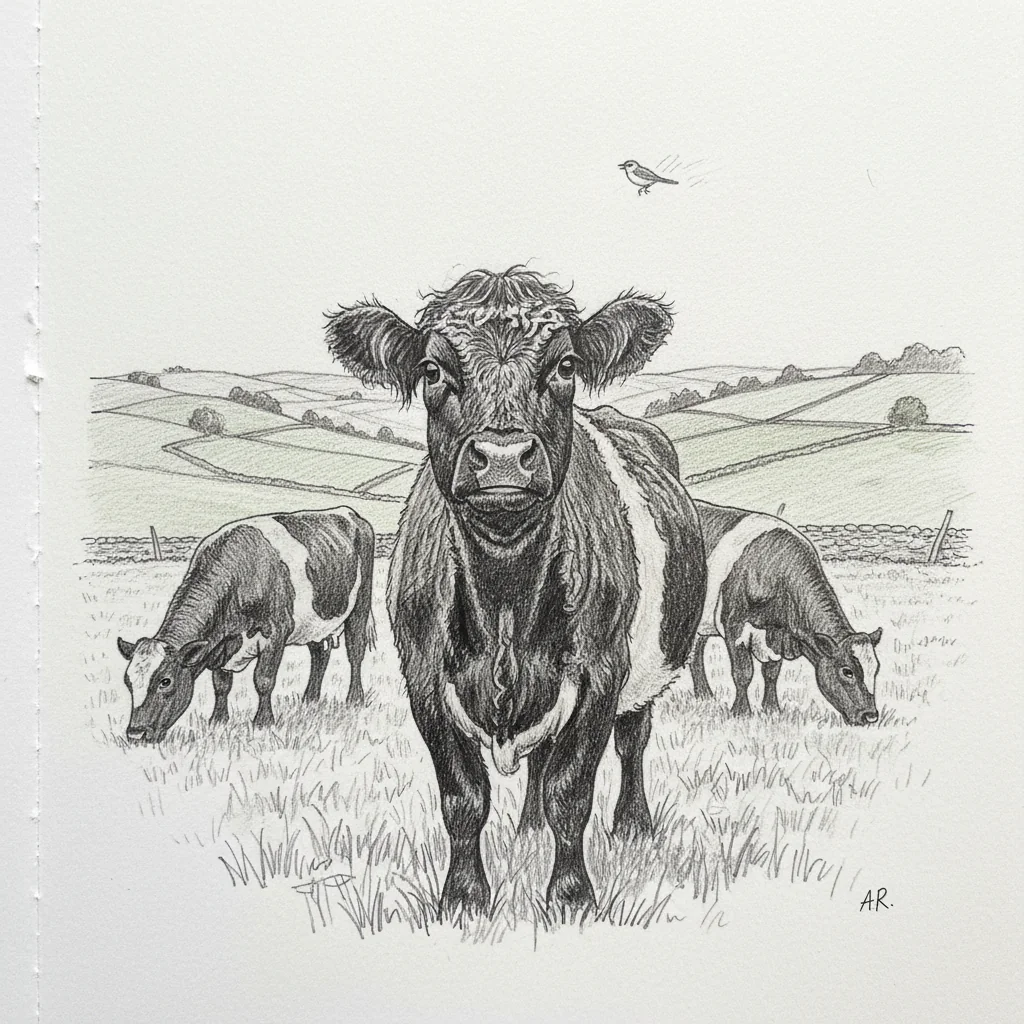
Belted Galloways below Snowshill
I pass a field of what I at first take to be the strangest cattle I have ever seen — hairy, black-headed-and-shouldered, white through the middle, with a black tail. Belted Galloways, I think. Belties. A Scottish beef breed with a shaggy double coat and a conspicuous white waistband, increasingly fashionable in Cotswold organic grazing schemes. Striking. A family group of three lambs with their mother keeps me company as the road climbs.
That was hill nine of nineteen. Which, the arithmetic reminds me, means ten is next. Ten is going to be the monster.
The Snowshill Estate signs point on to Snowshill Manor, two miles straight on. A final look back at Springhill, half-hidden across the folds of ground. The road crests at around two hundred and ninety-nine metres — the highest I will go today — and then, in a way the Cotswolds specialise in, it throws itself straight off the edge.
Forty miles an hour on the way down — a speed I will have to look up afterwards, because I am not, in the moment, keeping a close enough eye on the computer to confirm it. The kind of descent that demands your whole attention just to stay pointed forwards. The wind picks up. I have the Cotswold Way, a gorgeous footpath, running along the ridge I am now leaving; I have walked bits of it, I have run bits of it, I have never cycled past it before today. Coppice on my left briefly breaks the wind. The village of Broadway opens up at the foot of the slope, absolutely stunning: the long, wide High Street lined with honey-coloured limestone, the seventeenth-century Lygon Arms (renamed in the eighteen-thirties for the Lygon family, who had just bought Springhill from the Coventrys) slumped in one direction, the gatehouse of Broadway Court — all that now survives of a C16 mansion once owned by the Sheldon family — in another. I roll past the honey-coloured church, the parish church of Saint Michael and All Angels (though the older church, Saint Eadburgha’s, sits out on its own a mile down the road, twelfth-century, and if I had more time I would have gone and touched its walls).
I have ridden myself down about a hundred and seventy metres in a handful of minutes, grinning into the wind.
Then, and I had forgotten this bit, I have to put all of it back.
A yellow mountain sign appears on the Beeline, and the climb begins to rise in front of me. Not the A44 up Fish Hill, as it turns out — I am taking the smaller, older way: Buckle Street and Campden Lane, the rural lanes that cut up the scarp north-east of the tower rather than south-east of it. A hundred and seventy-three metres, the Beeline says, over one and a quarter miles. Long stretches of orange. Small stretches of red. I have never seen red on this display before. But the map is not the territory. The territory is what my legs are telling me.
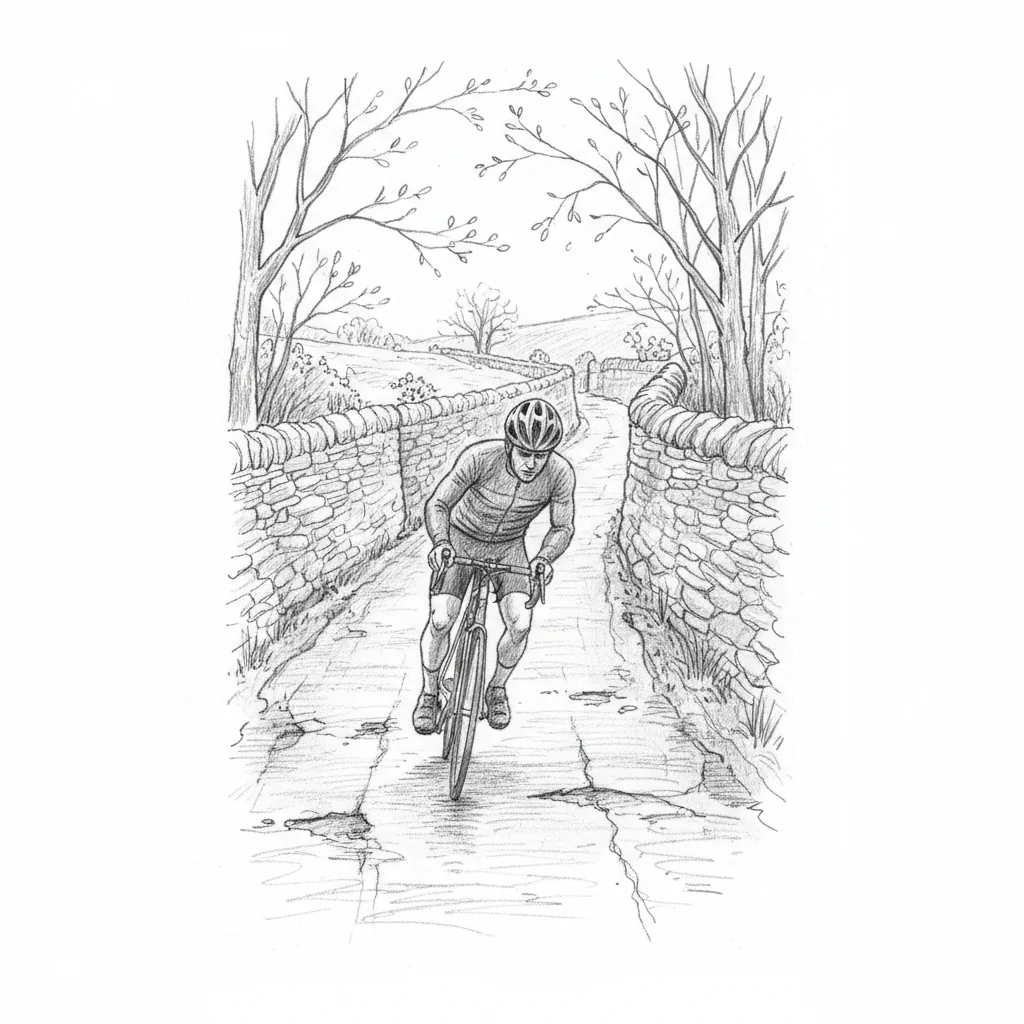
The road is wet. It is pot-holey. Not just on the edges: proper axle-deep holes in the middle of the lane — and axle-deep on a bike is not axle-deep on a car. A car winces. A bike stops being a bike. If you were coming down this you’d be braking hard the whole way, I think — missing out on most of the descent you’d just earned. I file that thought for later. The bottom gear — the new lower gear I’ve just added to the bike, the one I was going to use as an anchor — is suddenly not low enough. This is not even supposed to be the steepest bit.
Walking the red section, Buckle Street
I crank round another bend.
I am going to be honest with myself about what happens next.
A hundred and twenty metres to go. I can see the steep section coming up. And I have to stop.
The gradient at that stretch felt like a wall, and — pulling the GPX apart afterwards — it turns out it nearly was. Closer to one in six averaged over the worst four hundred metres, and into one in four over the steepest fifty metres of all. With my feet clipped to the pedals and zero momentum, I cannot clip out cleanly. I cannot generate enough power to unclip by pushing down, and I am in real danger of toppling sideways in traffic. I get my right foot out just in time. My dignity, less so. I stand there in the middle of the lane with the bike between my knees, panting.
And then I walk.
It is, as it turns out, fairly steep just to walk. Close to a face plant, I think; a learning curve; the cruelty of a bottom gear that isn’t quite low enough. A cyclist passes me going the other way — thank you, coming up behind you, cheers — and I mostly keep my shame internal. A runner passes me. I raise a hand.
Back in the saddle. Crawling at walking pace up the remainder of this hill.
And then: the top. The lane flattens out along the Cotswold ridge, the escarpment falling away behind, the long rolling Vale of Evesham smudged in haze off to the west. And there, off to my south and half-hidden in the trees, is the thing I have been aiming at all morning — Broadway Tower itself. A small, dark silhouette on the highest ground for miles, three storeys of hexagonal limestone with crenellations and gargoyles and three little round turrets at its corners. A proper folly, built for a view.
I will not quite reach it today. My route peels away north before the last turn, and the tower stays where it is — and that feels, unexpectedly, fine. The tower was commissioned in seventeen-ninety-eight by the sixth Earl of Coventry for his wife Barbara, after she wondered aloud whether a beacon built up on Broadway Hill might be visible from the family seat at Croome, twenty miles off across the Severn Vale. She was indulged. The first drawings came from the hand of Capability Brown — yes, the same Capability Brown who had built Springhill thirty years earlier, for the Earl’s uncle, the very house I had glimpsed that morning through a cut in the trees. (Told you.) Brown died before he saw the tower finished, and the job was completed by the Regency architect James Wyatt. They put it up in 1798 and 1799 at a little over one thousand feet above sea level — the second-highest point in the Cotswolds — and from its top it is said that you can see thirteen counties on a clear day.
Seventy years later the tower began its second life, the one that actually matters. William Morris took it as a summer retreat in the eighteen-seventies, and he went up there to stare at the view with Edward Burne-Jones and Dante Gabriel Rossetti — the Pre-Raphaelites at play in a Worcestershire folly. It was from Broadway Tower, watching the slow disfigurement of what he called the ancient fabric of England, that Morris nursed the outrage that led him to found the Society for the Protection of Ancient Buildings in eighteen-seventy-seven. An unlikely chain: from one countess’s idle question at a family dinner, to Capability Brown, to James Wyatt, to William Morris, to the SPAB. And then a century later the Arts-and-Crafts thread winds on down the ridge and lands in the attic of Snowshill Manor, where Charles Paget Wade will assemble his twenty-two thousand objects in the same conviction that the craftsmanship of the past is worth the trouble of saving. The Cotswolds are not short of hills. But they are unexpectedly well-supplied with people who looked at a view and decided to do something about it.
Today, on my bike, I am not one of those people. I pick up the A44 to head very approximately homewards, and my legs are killing me. There is a real risk of cramping. The serious part of the day is done, and the mental part has only just started.
◊
V. A Raspberry Flapjack at Ganborough
The A44 is busy in a way that the back lanes I have ridden out on absolutely were not. I am trying to hold a straight line while huge lorries swing past my left elbow at sixty miles an hour. There is nothing romantic about this part. This is just getting home.
After a while, blessedly, I turn off the A44. The café I was tempted by earlier is two miles ahead. I am retracing my steps, which is something I rarely do on a ride — I almost always choose a loop — but today’s big climb demanded an out-and-back shape, and there is a strange comfort in seeing familiar buildings coming up the other way.
Three hours in the saddle. Thirty-six miles done. Four hundred yards to the café, and please, please let it be open.
It is open.
The Cotswold Barn at Ganborough — in the parish of Longborough, a converted barn on a lane between the A424 and the Fosseway — is a family-run café and gift shop that won the Cotswolds Awards Best Café category in twenty twenty-three. Joanne and Bernard Williams run it with their daughter Lucy and her husband. Are you by yourself today? someone asks. Yes. Happy to sit outside if there’s space? Yes, yes, very happy. I take it you’re only here for coffee and cake? I mean, I would like a sausage sandwich. There would be a bit of a wait for that, I am told, gently. I look at my watch. I look at my legs. I look, mostly, at the sky. In that case, something sweet. Instant energy. One of your flapjacks, please. And tea — yes, a pot of tea, that would be fantastic.
A raspberry flapjack and a couple of mugs of tea arrive. I sit in the sun, and my feet start, very slowly, to belong to me again.
Café stop complete. Refuelled. Twenty miles still to go.
◊
VI. The Long Way Home
The climb back into Stow is the first reminder that the hills are not quite done with me. A hundred and forty-one metres of ascent over a single mile, on top of three hours of riding, with the Cotswold wind — which has been in my face most of the morning — now behaving itself for the first time all day. Stow sits at eight hundred feet above sea level, the highest of the Cotswold towns, at the junction of the Fosse Way and several other ancient roads. It has held a market since eleven-oh-seven. It held a Royalist army in sixteen-forty-six during the last pitched battle of the First English Civil War, with the prisoners afterwards crammed into Saint Edward’s Church. All of this feels, on tired legs, frankly a lot to hold in one’s head while also trying to negotiate the traffic lights on the High Street.
Down the other side of Stow and back to Bledington. A group of walkers is camped out on the tiny green. I have always preferred circular routes to out-and-backs, but there is something unexpectedly comforting about revisiting. Two hours ago these hedges were new. Now I know exactly where I am.
One mile from Kingham station. The hills have been kind for the last half hour, which means we must be quite low by now. I am going to have to pay that back.
I pass the sign to the Wild Rabbit again. Again, not today.
An unusual road — a level crossing, little used — and then, just after it, an enormous house with gardens on my left, the kind of house that must belong to some very comfortable someone. I don’t quite know where I am at the moment. A moment later I realise I am on the outskirts of Shipton, heading round the back of Bruern — a Cistercian abbey founded in eleven-forty-seven, dissolved by Henry VIII in fifteen-thirty-six, and later a country house and a specialist prep school for boys with dyslexia and dyscalculia, which has recently relocated elsewhere. The house I was ogling is presumably on the abbey estate.
I cross the Darcy Dalton Way while also riding the Oxfordshire Way. Two long-distance paths converging on the same bit of Oxfordshire at the same instant. Good company to be in.
Bluebells are just poking through the undergrowth where the sunlight reaches it. The new leaves are that impossible, almost luminous green, the green that only lasts a few weeks in spring. Little white moths, or butterflies — I don’t stop long enough to tell — dance in the verges. This is rather pleasant, aching legs aside.
I roll through the fifty-mile mark at three hours fifty-three. Fifteen hills done, apparently; the computer has quietly reset to seventeen hills without explaining where the other two went. I am very glad to have lost them.
Quick situation report, seventeen minutes past one. Fifty-three miles, four hours eleven. The new gearing is working really well, except when I click into it when I don’t need it. It did not quite stop me walking, but it has definitely got me further than I would have got.
I have not yet fallen over by having my feet stuck in the pedals. I’ve come close a couple of times. I think they are giving me a little bit of extra. It’s a marginal gain. I’ll take marginal gains on long runs, on long rides, anywhere.
The spire at Leafield — my homing beacon
Fresh tarmac appears just outside Leafield. Somebody has very kindly laid some nice smooth asphalt down, and with a slight tailwind the bike almost floats for a hundred yards. Hill sixteen arrives and leaves so quickly I’m not certain it counted.
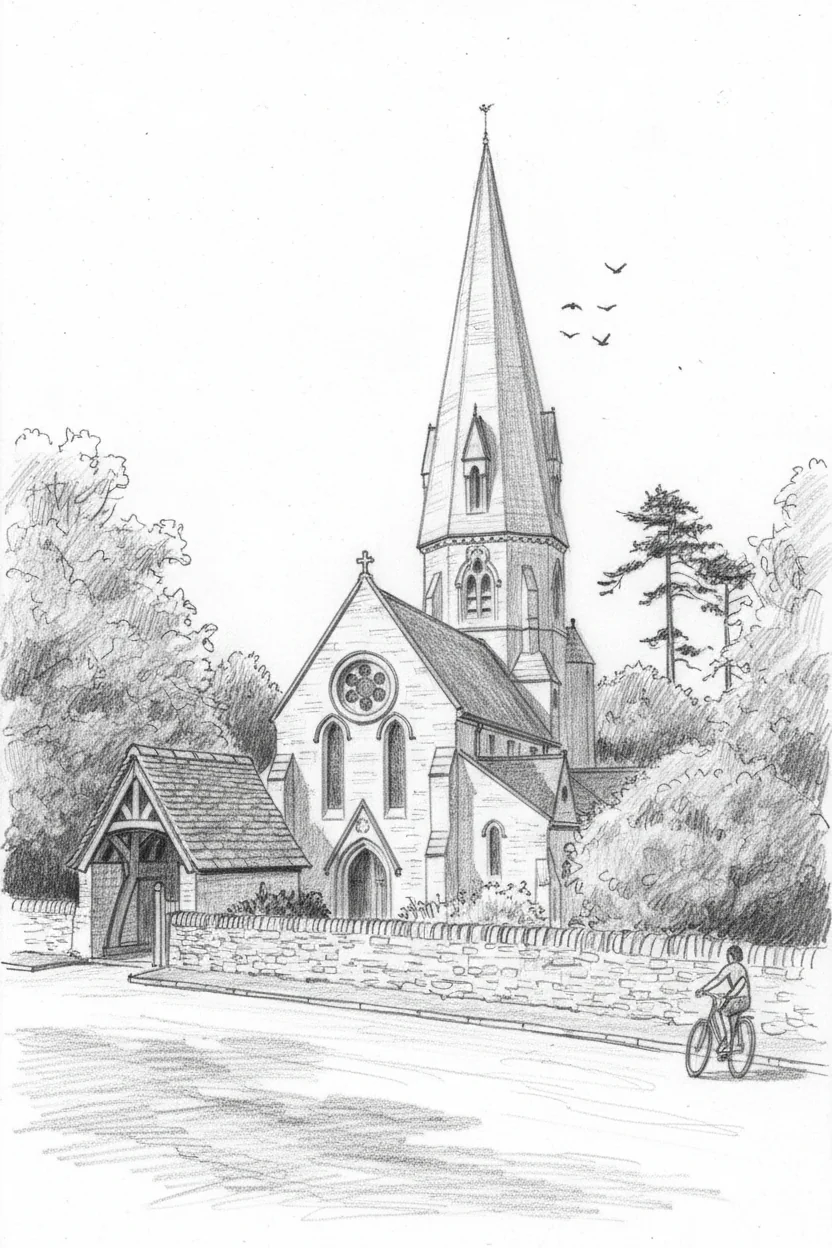
Then the spire of Leafield church appears above the trees — the same Gilbert Scott spire I have described before, in other posts, on other rides. Today it earns a different sentence. It has been my navigation aid for the last forty miles without my quite realising it. Every time I glimpsed a spire on the horizon I knew where home was, even before I had put the name to it. A landmark becomes personal through repetition, and by now this one is mine.
And Leafield is nearly home.
The descent from Leafield into Crawley is the kind of single-track road where you have to remember that someone might be coming the other way at any moment. Fast, but bumpy, grit scattered on the corners. A quick crossing of the Windrush at Crawley Bridge — the stone bridge that has stood here since the fifteenth century, rebuilt with three arches in eighteen thirty-three. One last small climb into Witney. And home.
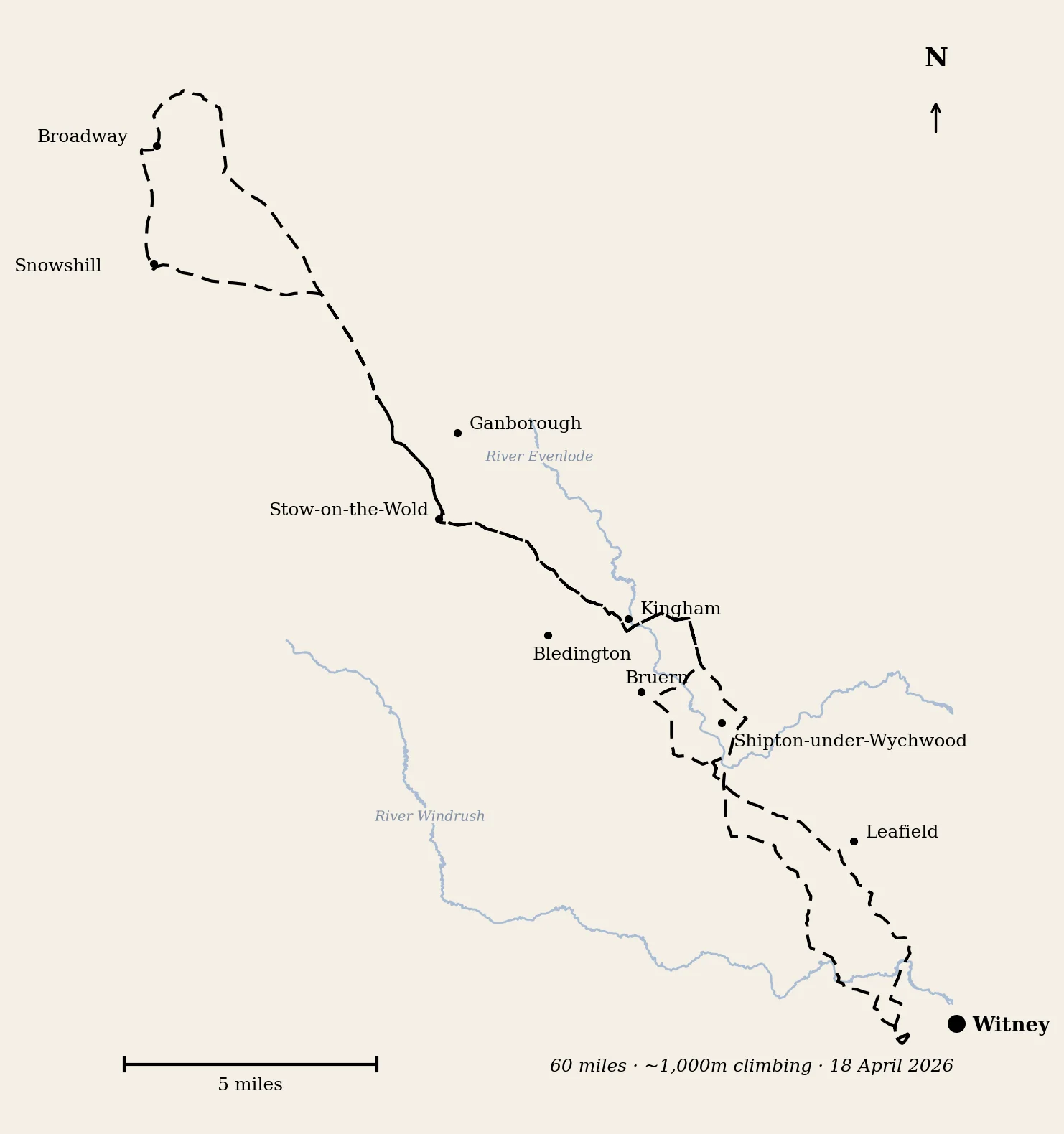
Sixty miles. Roughly a thousand metres of climbing (the Beeline’s raw GPS figure of just over two thousand is almost certainly inflated). Four hours, fifty minutes, door to door. One raspberry flapjack. Two mugs of tea. Three red kites in a holding pattern. One skylark. One field of Belted Galloways. Multiple generations of pheasants doing their best not to be seen. One buzzard pacing me down a lane. A field of lambs doing their two-legged jump. One mediaeval hunting lodge glimpsed from the hillside. Springhill House glimpsed through a cut in the trees. One cabinet minister, absent but implied, being towed off a pothole by the AA. Nineteen hills. Or seventeen. And one walk up a red section, which I will file under experience. Not bad for a Saturday.