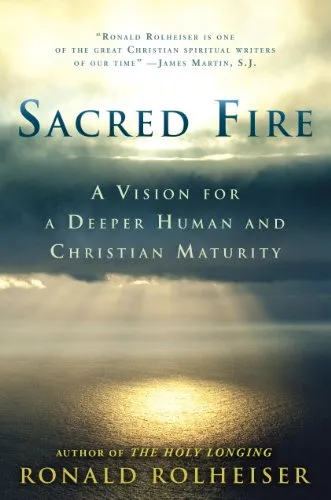
Sacred Fire
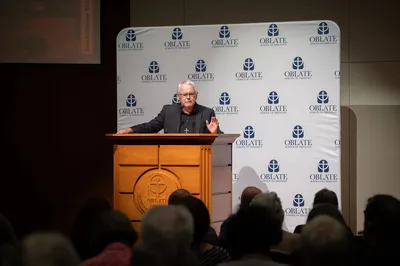
The author explores the stages of spiritual maturity and how to live a life of deep discipleship and generosity in the second half of life.
Growing up and maturing is precisely a process of fermentation. It does not happen easily, without effort and without breakdown. But it happens almost despite us, because such is the effect of a conspiracy between God and nature to mellow the soul.
the famous parable of the prodigal son and his older brother can serve as a paradigm for this: the prodigal son, illustrating the first half of life, is very much caught up in the fiery energies of youth and is, metaphorically, struggling with the devil; the older brother, illustrating the second half of life, struggling instead with resentment, anger, and jealousy, is, metaphorically and in reality, wrestling with God.
It is no secret that today one of the major reasons why many young people, and indeed people of all ages, are no longer going regularly to their churches has to do, in one way or the other, with their struggles with sexuality and their perception of how their churches view their situation.
Scripture scholars tell us that, for Jesus, the opposite of faith was not doubt or unbelief, but anxiety, being anxious.
If we were brought to trial in a court of law and accused of being a Christian, what characteristics would we have to exhibit for there to be enough evidence to convict us?
if we unpack more fully what is contained in Jesus’ formula for discipleship, we can name four constitutive elements: i) private prayer and private integrity; ii) charity and justice; iii) involvement within an ecclesial community; and iv) forgiveness and mellowness of heart.
Hence, we are essentially following Jesus only when, among other things, in our lives there is some regular effort at private prayer and that effort is matched by a regular effort to keep the commandments and keep our private morals intact. Private prayer and private morality are one of the nonnegotiable demands inherent within Christian discipleship.
Being with others regularly, within a community of worship, fellowship, and service is one of the essential, nonnegotiable elements of Christian discipleship.
On the surface, the text reads this way: Israel, after having conquered the Promised Land, is asked by God to kill all the original inhabitants of the land, the Canaanites. Taken literally, this is a horrible command, one that would erase our very concept of God’s goodness and impartiality. God, seemingly, commands the Israelites to kill every Canaanite in the land—including all the women and the children, and even their cattle and domestic pets. Does God actually do this? Clearly, this must be read metaphorically and archetypally. Nobody really dies in a metaphor. This is a drama that is meant to take place inside the soul of every person once one has converted and begins to move into one’s new life, the Promised Land. The “Canaanites” are a metaphor for one’s old life and one’s old habits.
Like the biblical Martha, the supper gets cooked only if we do the cooking and the mortgage gets paid only if we earn the money. We are in charge. We are responsible. We carry the car keys, the house keys, and the debt for both. The major load is on our shoulders, and sometimes it feels as if we are on a treadmill with no way of stepping off. Consequently, all too often, despite the privilege of being young, being healthy, and being in charge, it is easy to feel burdened, taken for granted, unappreciated, and used by others. Like Martha in scripture, it is easy to feel resentment because we seem to be doing all the work while others are getting more of a free ride.
There is something worse than having too much to do, and that is having nothing to do or too little to do of importance. We will be a lot more awake to that fact when we sit in a retirement home, stripped of youth, health, and our car keys, knowing that all those years when we thought we were being taken for granted were years of privilege that were laden with a potential for joy that—because of our unawareness of privilege—we never quite picked up on.
With most other addictions, we are eventually sent off to a clinic, but if we are addicted to our work, we are generally admired for our disease.
As we age we need to forgive—forgive those who hurt us, forgive ourselves for our own mistakes, forgive life for having been unfair, and then forgive God for seemingly not having protected us—all of this so that we do not die bitter and angry, which is perhaps the greatest religious imperative of all.
Jesus defines it this way: God, he says, lets his sun shine on the bad as well as the good. God’s love does not discriminate; it simply embraces everything. Like the sun, it does not shine selectively, shedding its warmth on the vegetables because they are good and refusing warmth to the weeds because they are bad. It just shines, and everything irrespective of its condition receives its warmth. This is a stunning truth: God loves us when we are good, and God loves us when we are bad. God loves the saints in heaven, and God equally loves the devils in hell. They merely respond differently.
If God loves us equally when we are bad and when we are good, then why be good? This is an interesting question, though not a deep one. Love, understood properly, is never a reward for being good. Goodness, rather, is always a consequence of having been loved. We are not loved because we are good, but hopefully we become good as we experience love.