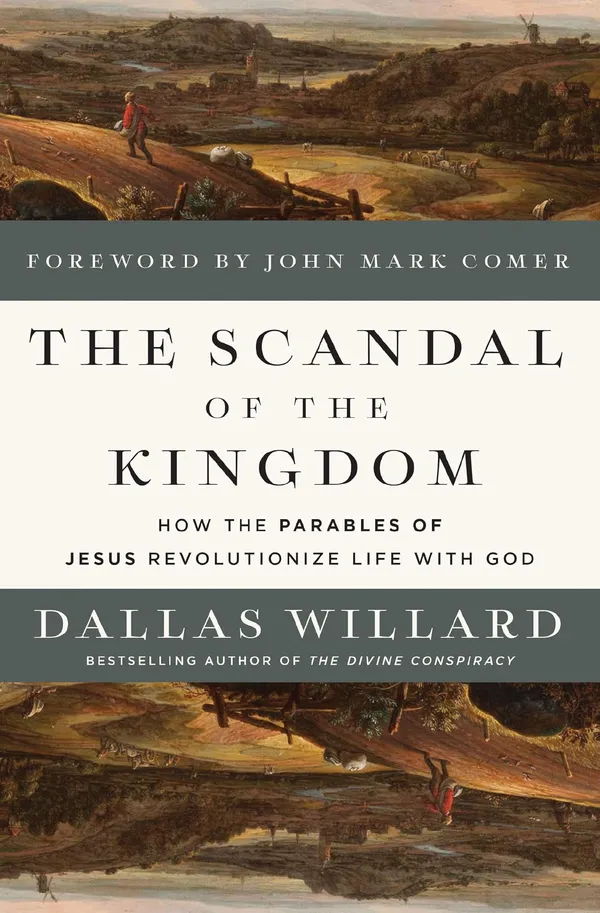
The Scandal of the Kingdom
This work examines the countercultural nature of the teachings of Jesus and how they challenge modern social and religious norms.
Unlike the kingdom of God, human government functions on principles of force, deception, brutality, and the power of death. All human governments have the power of death, but what they lack is the power of life. This is what the kingdom of God has: the power of life. Human governments can kill. God’s government gives life. This life is based upon the new birth that is an entry into the kingdom of God.
If we don’t understand how he taught, legalism will run rampant because we will interpret what he was saying as laws. This is a very common mistake, especially with the Sermon on the Mount and the Sermon on the Plain.
Jesus constantly used careful and creative employment of the power of logical insight throughout his teaching to enable people to come to the truth about themselves and about God from the inside of their own hearts and minds.
So it is wise to examine Jesus’ teachings and ask if he is giving a general command or offering an illustration of a kingdom principle and what it might look like. If it’s an illustration, ask yourself, What prevailing cultural presumption is he trying to correct?
Parables became one of the primary ways Jesus disrupted the default way of thinking in his culture. The word parable (parabole) comes from two Greek words that mean “to place or throw beside.” Para means “beside,” as in parallel lines; bole means “to throw or to place.” Teaching by parables means placing two things next to each other in order to learn more about them through contrast and comparison.
You see, the parables are an act of mercy to us because sometimes our hearts are hard. You and I both know that if we directly challenge someone with a hard heart, their heart will get even harder. So in his love, mercy, and compassion, Jesus told a story.
Not everyone has ears to hear or eyes to see. Many people use them primarily as filtering and sorting devices. Teachers see this in classrooms. If a student thinks they already know the subject or have “heard it all before,” they simply stop listening. The teacher is faced with the dilemma of how to get through to them when their minds are turned off. Any time the teacher tries to address the material again, it signals the student to switch their mind off again.
When a human being says, “I want to have my way!” God says, “Alright, you can have your way.” Sadly, the worst thing that can ever happen to a human being is to have their way when that way does not include God.
The primary function of the will is to trust God. The set of a person’s will is key for how the Word of God affects the mind because the will and mind are deeply integrated. On the one hand, what the mind dwells on determines what the will chooses to act on; on the other hand, the orientation of the will may determine what stays in the mind. It’s important to ask ourselves, What is my mind dwelling on and why is it dwelling there?
When Jesus said, “Do not worry about your life, what you will eat or what you will drink; nor about your body, what you will put on. Is not life more than food and the body more than clothing?” (6:25), he was not saying, “Don’t iron your clothes” or, “Don’t think about cooking dinner.” He was saying, “If thoughts of food, clothing, and material goods are uppermost in your mind, those thoughts will run your life.” The desire for pleasures and belongings can create a bondage to material goods that entangles us in a complexity that wears us down and wears us out.
There is a kingdom of God we’re all being invited to live in, and we can know it by experiencing its reality. We can come to know the presence of the King in our lives with such constancy and power that even when we are suffering great pain or lying down to die, we can feel and know the presence of the kingdom and be blessed.
The seed is a power to organize reality. Please think about that for a moment. When you put that little seed down in the earth, it’s already packed with potent substances. The power contained within it cracks the shell of the seed and puts out a little root. That little root starts eating dirt, eventually putting out a little leaf, then more leaves, and then fruit. The seed has organized reality in a specific and defined way to make a watermelon out of dirt, water, and sunlight.
The expression “division of soul and spirit” is one of those delicious phrases that invites further study. The soul is fundamentally the life principle that is in the individual person, given to them by God, which makes their body and mind function. The spirit is the element that is especially given by God to hold the soul and body together. When Jesus died, he said, “Unto you I surrender my spirit” (Luke 23:46, paraphrased), not “my soul” or “my body,” but “my spirit.” “God is spirit” (John 4:24 NIV)—not soul, not body; in defining God, he is spirit.
God’s Word is a substance that offers sustenance, just as food does. We live in two landscapes—the physical and the invisible—and when we fast, we are taking in substance from the invisible landscape. We are learning how to live on the nourishment of the Word of God.
We don’t fast to prove our goodness to God, to others, or even to ourselves.
Fasting helps us to learn inwardly what it is like to live on the nourishing, substantial, living, powerful Word of God.
The gospel of the kingdom of God is also not a gospel only of the death, burial, and resurrection of Jesus Christ. That is part of the gospel of the kingdom of God, but it is not the whole gospel.† I remind you that Jesus Christ himself did not preach that historical reality as the whole gospel. The gospel of our Lord Jesus Christ is the present availability of the kingdom of God.
This helps us understand what salvation is in the New Testament sense. This salvation includes three things that are available to us: Forgiveness of sins. Through the work of Christ and his substitutionary stand before God on our behalf, our sins are forgiven through the mercy of God. Transformation of character into the image of Jesus Christ. We are meant to be conformed to the image of Jesus Christ (Romans 8:29). This is a work of grace just as much as the forgiveness of sins. And there is nowhere any indication that this is something that is supposed to happen after we die. A significant degree of power over evil, both in our own lives and in the life of the church of which we are essentially a part.
Grace doesn’t mean we do nothing. The farmer went out and sowed the seed. Grace is not opposed to effort (that’s an action), but rather to earning (that’s an attitude).
We very badly need to hear this message of our responsibility for individuals who are in need. Even if we are giving money to charitable organizations, we should never avoid skin-to-skin contact with people who are in need.
Most of the insanity of the world in which we live is due to the fact that eyes are not lifted to heaven. That’s what puts everything into the perspective of reality,
Some churches today have a problem of attracting good, sensible, thoughtful people who aren’t particularly interested in having God be in charge. These people are not mean, and they’re not trying to do anything wrong. They say, “I want to be a good person. I believe in God. I want to associate with a church that is dynamic.” So they come to church, and because they are hardworking, intelligent, highly motivated people, they soon carry the burdens of leading the church. As they gradually start to take over and run the show, they forget who’s in charge, just like Nebuchadnezzar did. And the church continues to grow and prosper. But if God were to die, they might never know it because the church is simply functioning on good organizational principles and effective means of socialization.
Eternal life does not come from the Scriptures apart from Jesus Christ, to whom the Scriptures point. It doesn’t matter how high your view is of inspiration—how firmly you believe that the Bible is the Word of God—you can go to hell hugging it to your chest if you don’t find the Christ of the Scriptures.
Main Points About the Kingdom of God The Parable of the Workers in the Vineyard brings out the tragic fact that leaders in God’s kingdom, past and present, sometimes have hard hearts and develop institutions that lead against God. Disciples of Jesus exemplify eternal living and bring it to bear on everything around them because their lives are caught up in God’s life as they steward his kingdom on earth. Leadership as God intends is a major element in the structure of love and care for each other, and this type of leadership is imperative for those living in community. Doing God’s will is about having the faith of Jesus and living as Jesus taught, becoming more and more like him in our character and habits. Christian leaders must act with the understanding that God is acting with them.
I’m sure this father had grounds to worry about his son, but most children eventually mature enough that the parents’ role in their lives becomes one of helping them do what they want to do. You may say, “But that’s dangerous!” But it is the giving, helping heart of the father and mother that will win the child, not the condemning heart that says, “No, I don’t trust you. I have no confidence in you.”
Our children were given to us to love, not to sit on. And while we often feel responsible for their behavior, there comes a moment when we have to turn them loose and say, “I’ll help you.” We need to have confidence in them because we have confidence in God. The father in the parable understood the difficulty his son was facing, and he chose to help his son.
The surest way to lead someone in the path of goodness is to be merciful to them. The surest way to drive them into wrongdoing and anger is to be unmerciful. It is the power of mercy that conquers the hardened heart. You may think, It’s all right for God to be merciful, but what’s going to happen if I’m merciful? Won’t they just do it again? God can afford mercy, but I don’t think I can. It’s only when we step into the path of mercy that we begin to live in the power of God. It is in the stream of mercy we begin to live without holding anything against anyone—forgiving, giving, and reconciling—and truly know the abundance of God that can meet all of our needs.
Character is not about what people do, but rather about what they would or could do given the opportunity. The opportunity reveals where their heart has been aimed all along.
The plots of countless novels and movies focus on revenge, on getting even. But no one ever really gets even because one person will not count as “even” anything but what the other person counts as “beyond.” It seems to be built into the human condition that getting even never works. For example, when children fight, that last punch or insult is what matters. Whatever was done last is somehow bigger than anything that came before it. No one ever tries to get even by letting someone else have the last word or the last blow.
Jesus. One of the great spiritual practices is not having the last word.
In our actions toward those who wrong us, we no longer hold them responsible or base our behavior toward them on what they’ve done. We lay down the grudge. The inward side of forgiving means we no longer brood, dwelling on the hurt or wrong. We have come to some degree of liberty from the hurt because we have chosen to look to the future.
Don’t assume the burden of making forgiveness happen. Your part is to fill your mind with Christ. Pray for the grace of forgiveness to come through you to others, because it must, after all, come from God. It came to us through another—namely, Jesus Christ. And then concentrate on the good to be done, first of all, in your own life. Sometimes this may mean simply paying attention to the beauty of the flowers in your backyard. God made them and gave them to you to fill your heart with joy, so pay attention to them.
Many of our troubles stay with us because we don’t accept the little, wonderful things that God places in our lives every day, such as the simple pleasures of eating and resting.
Forgiveness can become a simple, straightforward act done because it is the best thing to do—not because you have to and not to try to prove anything about yourself. It’s simply the wise thing to do. That’s why God forgives.
Thomas Aquinas is said to have noticed the same pattern. Once, when Aquinas was in Rome and in the presence of the pope, before whom a large sum of money was spread out, the pope observed, “You see, the Church can no longer say, ‘Silver and gold have I none.’” “True, holy father,” replied Aquinas, “but neither can she now say, ‘Rise and walk.’”
When people become concerned about doing God’s will, they wonder, What does God want me to do? But God is there next to them, asking, “What do you want to do?” God wants to have conversations with us about what we want to do and about his purposes for our lives. God wants to help us grow and mature, and sometimes he does this by being quiet and allowing us to make our own choices based on our deepening relationship with him. That’s when we discover what we truly are before God.
Anyone who is unwilling to consistently lift their requests before the Lord in prayer is like a person who learns that a plant needs a full day of sunshine but only sets it outside for five minutes every morning.
knew. The interesting thing about witnessing and teaching is that most folks already know what they need to know. They already have an idea about the answers. Sometimes they need something clarified or confirmed, or maybe they need an example laid out for them, but basically they know. This same concept applies to condemnation. We hardly ever need to condemn anyone because they’ve already condemned themselves.